Asset Review:  3Jane USD3
| Item | Detail |
|---|---|
| Asset | 3Jane USD3 |
| Asset type | Senior lending-vault share |
| Deployment | Ethereum (0x056B…5eCc) |
| Review date | 14 September 2026 |
| Official links | Website · Docs · GitHub · X |
- Asset overview
- At a glance
- Issuer and organization
- Mechanics and dependencies
- Governance and control
- Exits and market liquidity
- Valuation and oracle considerations
- Security and operational history
- Risk summary
Asset overview
USD3 is the senior share of 3Jane’s USDC lending pool on Ethereum12, with approximately 80 million USDC in reported assets.3 Depositors receive shares whose USDC value grows with income and can fall with losses.2
Staking USD3 for sUSD3 provides additional income in exchange for taking losses first.24 This junior position gives other USD3 holders limited loss protection.2 Withdrawals still depend on available USDC.2
At a glance
- Yield: Borrower interest and Aave yield.
- Exposure: Primarily offchain lending. Slope business loans account for about 71% of reported assets; LendSwift adds consumer lending.
- Loss buffer: Unreleased profits, then junior backing worth 7.66 million USDC (9.6% of reported assets).
- Valuation: Reported pool value; loan losses can be recognised late.
- Redemptions: Approximately 12.40 million USDC available, or 15.5% of reported assets. Withdrawals settle immediately when funded; detected, unreported losses block access.
- Liquidity: USD3 can also be sold through Curve. A simulated sale worth 1.18 million USDC executed within 0.1% of reported value. Larger sales were limited by available liquidity.
- Access: No transfer blacklist or whitelist; deposit whitelisting is inactive.
- Lockups: No active deposit lock; governance can delay transfers and withdrawals after each wallet’s latest deposit.
- Recovery: Offchain collections and legal enforcement; creditor priority could not be verified.
Issuer and organization
3Jane was founded by Jacob Chudnovsky and raised a reported $5.2 million seed round led by Paradigm in June 2025.5 Its website terms identify Tulkum Assets Corp., a Panamanian company, as the website operator.6
Lending partners and exposures
Slope lends to small and medium-sized businesses.7 3Jane’s 10 September 2026 facility report lists $56.75 million deployed across 1,580 purchased loans, with Slope administering the loans and collecting repayments.78 This exposure represents about 71% of reported pool assets.38
The report classifies 96.2% of balances as up to date on payments, 1.2% as at least 30 days late and none as written off.9 About 79% of collateral comes from loans originated during July–September 2026, so most of the portfolio has a short performance history.9 The portfolio is paying down, with an average remaining loan term of 46 days, weighted by loan balance.8
LendSwift lends to U.S. consumers.7 3Jane’s facility provides up to $10 million at 15% annual interest, financing up to 75% of eligible loan value while LendSwift contributes 25% and bears losses first.7 This contribution protects the LendSwift facility;7 Slope’s reported advance rate is 100%, with no equivalent contribution shown.8 LendSwift can reuse repayments to finance new loans until 26 May 2027; full repayment is due by 26 November 2027.7 Individual loans can therefore repay before 3Jane’s funding is returned.
The 11 September 2026 facility report covers 21,303 loans and $5.71 million of principal funded by 3Jane.9 About 38.4% of the gross loan balance is at least 16 days late, with a balance-weighted borrower APR of approximately 693%.9 That APR measures the annualized borrowing cost to LendSwift’s customers, rather than the 15% interest payable to 3Jane.7
The collateral calculation deducts amounts for delinquency and payment shortfalls.9 After those deductions, and including collection cash, 3Jane’s LendSwift facility report lists $8.26 million of net collateral against $5.79 million of senior obligations—43% excess collateral, above the required 33%.9 This provides a cushion against further losses. The figures come from the facility report and have not been independently verified.
The two lending relationships spread exposure across thousands of underlying loans, while underwriting and collections remain concentrated in a small number of originators and servicers.78
Collections and legal protections
According to 3Jane, 3Jane Capital Corporation (3JCC) is a dedicated asset-holding SPV separate from WebMonarch, the protocol’s development company.10 In the reviewed facilities, 3JCC purchases Slope’s loans outright and lends against receivables pledged into a LendSwift-side SPV.710 These structures are intended to separate loan assets from operating-business risk;7 other or future facilities may use different arrangements.
3Jane uses Erebor Bank for conversion, facility transfers and collections before funds return onchain.11 Its dashboard reports $3.08 million in bank staging.8 Bank-held cash must return onchain before it can fund USD3 withdrawals.2
The review did not include the signed agreements and bank records needed to verify creditor priority, ownership and control of collection accounts, and the reported cash balance.78 Public disclosures also did not identify a backup servicer or a timetable for taking over collections.8
Mechanics and dependencies
How funds reach borrowers
The strategy converts USDC into waUSDC, a token representing USDC deposited in Aave, then supplies it to MorphoCredit.2 Unborrowed waUSDC can be converted back into USDC.2 Once funds are borrowed, the pool relies on the borrower’s obligation to repay.12 MorphoCredit holds no borrower collateral that can be sold through an ordinary onchain liquidation;12 recovery relies on repayment or the offchain protections described above.7
Approximately 67.64 million USDC is recorded as credit.3 One staging account controlled by 3Jane’s main governance wallet holds 97.4% of the market’s debt shares, which record each account’s proportion of borrowing.13 The app attributes most of this funding to fintech facilities and bank cash.8 The account therefore channels funding to several underlying exposures. Those facility and bank balances have different reporting dates and describe uses of the same credit position, not additional backing.38
The strategy may lend up to 100% of available waUSDC.23 A separate lending limit linked to junior backing is disabled.23 Auditor Guardian identified that borrowed funds could inflate the junior holdings used to calculate that limit.14 This matters if the limit is enabled; it does not establish that the existing junior holdings were funded through borrowing.
Income and loss protection
The pool earns borrower interest and yield on its Aave deposits.12 Interest can enter reported value before borrowers pay it.212 3Jane says it allows for expected credit losses before reporting profit onchain, increasing the allowance as delinquencies rise and reducing the interest passed to the pool.10 Its funding and treatment in onchain accounts were not verified.
When the strategy reports a profit, 7.5% is allocated to sUSD3 through newly issued shares.23 The remainder increases USD3’s share value over three days; the unreleased portion is called locked profit.23 Separate JANE rewards are currently non-transferable.1516
The junior buffer consists of USD3 shares held by sUSD3.4 Reported losses first consume locked profit, then burn junior-held shares, leaving other USD3 holders with a larger proportion of the remaining assets.24 This absorbs losses without replenishing the vault’s USDC. The junior claim is worth about 7.66 million USDC (9.6% of reported assets), with approximately 15,700 USDC of profit still locked.3 Figure 1 shows how losses beyond that buffer reduce other holders’ claims.
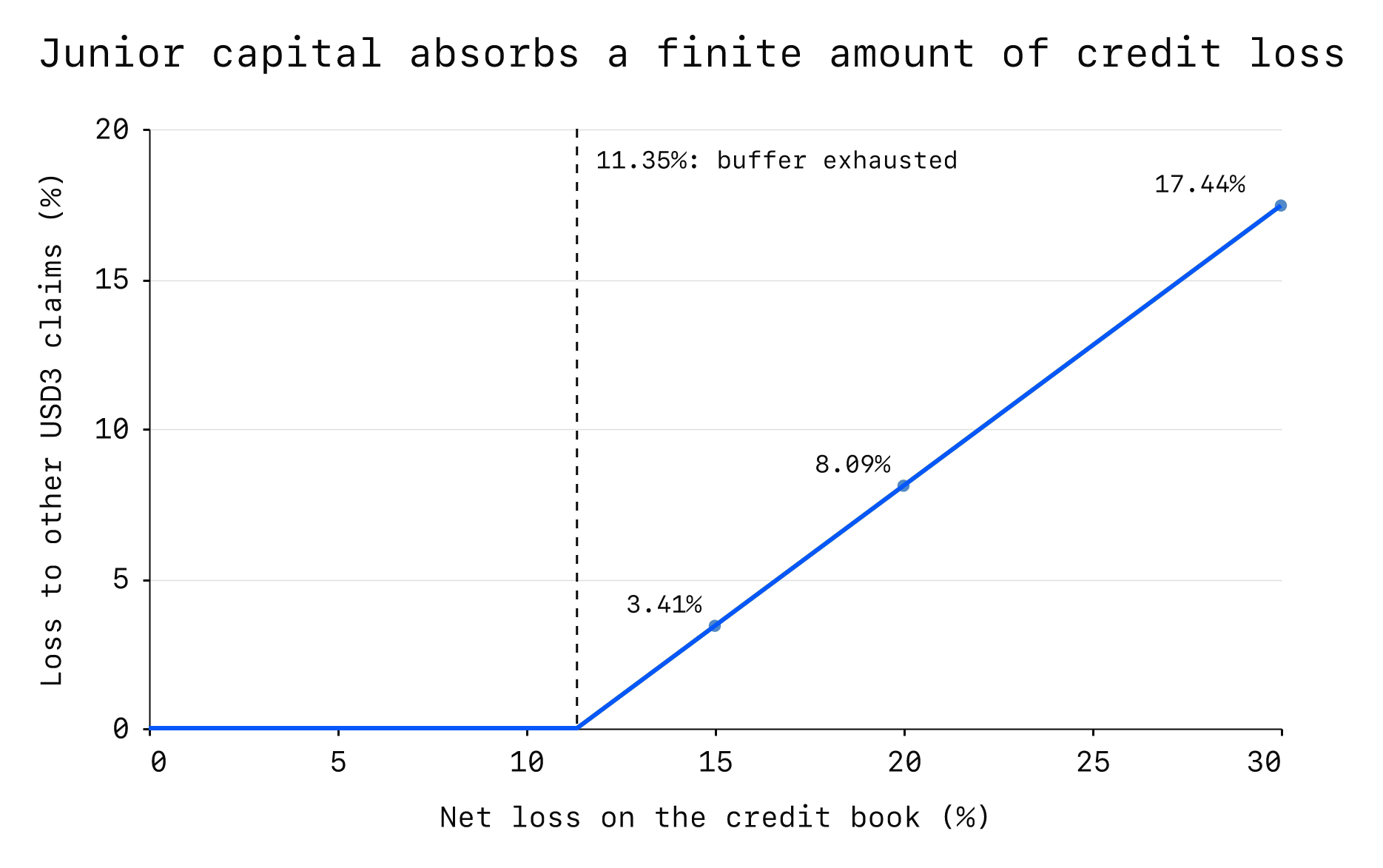
Figure 1. Junior capital absorbs the first losses, then other USD3 holders share the remainder. Source: original calculations from pool accounting, assuming immediate recognition and fixed holdings.17
These scenarios apply an immediate net loss to the reported onchain credit position after facility-level recoveries, with no new income, deposits or exits. No separate expected-loss reserve or discretionary insurance is added to the modeled protection.
Ordinary junior withdrawals require a 30-day wait and must leave at least 7.5 million USDC of junior backing.34 Approximately 161,000 USDC is currently above that minimum.3 A junior shutdown waives both restrictions, while retaining checks for unreported losses.4
The separate InsuranceFund smart contract holds waUSDC worth approximately 1.03 million USDC.18 Authorized credit managers can use it to repay debt in waUSDC during settlement, subject to the contract’s conditions; it does not automatically absorb USD3 losses.18 Converting available waUSDC into USDC for withdrawals still depends on Aave.19
Loss recognition and withdrawal access
MorphoCredit records outstanding debt across 16 onchain borrowing accounts.13 Most borrowing passes through 3Jane’s staging account, which holds 97.4% of debt shares and channels funding into the underlying lending arrangements.13 These accounts are distinct from the individual businesses and consumers borrowing through Slope and LendSwift.8
All 16 have zero amounts due in the onchain repayment record and scheduled loan-value reductions, called markdowns, switched off.13 This does not mean the underlying borrowers owe no payments. Loan deterioration can remain outside USD3’s reported value until 3Jane updates the accounts or settles the debt.12 Routine USD3 reports do not update each borrower’s individual premium or markdown.212
Once the strategy detects a loss, it blocks withdrawals until that loss is reported.2 This prevents withdrawals at a recorded value the strategy knows is too high, but it cannot identify losses missing from the underlying loan accounts. The automated reporter updates both tranches, but its current loss-tolerance setting rejects loss reports.20 Management must change that setting or report directly before withdrawals can resume.24
A simulated write-off of a smaller borrower illustrates the sequence: withdrawals stopped, management reported the loss, junior shares absorbed it, and withdrawals resumed without materially changing USD3’s share value.21 The simulation assumes management has the required authority and any timelock delay has passed; it does not establish how quickly intervention would occur.
Token behavior and restrictions
USD3 supports ordinary transfers and spending approvals, with no transfer blacklist or whitelist.222 Its optional deposit whitelist is disabled.23 Accounts with outstanding borrower debt shares cannot deposit.2
The deposit lock is currently set to zero.3 Governance can set one waiting period for everyone; while enabled, each new deposit restarts the receiving wallet’s clock, restricting that wallet’s transfers and withdrawals until it expires.2 The clock applies to the wallet’s balance rather than individual shares. Incoming transfers do not restart it, and transfers to or from sUSD3 are exempt.2 While the lock is enabled, only approved callers can deposit for another wallet; otherwise, depositors must receive their own shares.2
Circle can pause USDC or blacklist addresses.23 Aave authorities can pause waUSDC or the USDC reserve and interrupt native withdrawals.19 A reserve deposit freeze alone does not block withdrawals.19 These controls can interrupt access to USDC even while USD3 remains transferable.
Governance and control
A 3-of-5 Safe controls changes to protocol settings through a one-day timelock and core upgrades through a seven-day timelock.24 At least three signers must approve an action before the applicable delay.24 The same Safe owns the staging account.13 The signing threshold is verified, although the signers’ identities and independence have not been established.
Management can change credit limits, repayment obligations, fees, deposit restrictions and junior protection settings.2412 Core upgrades can change the strategy’s behavior after the seven-day delay.24 These approval requirements and delays constrain changes, while holders continue to rely on 3Jane’s credit management.
An emergency controller can immediately pause borrowing and new deposits into MorphoCredit, reduce selected limits to zero and revoke credit limits.25 Restoring parameters requires the normal governance authorization process.25 These emergency powers can restrict activity quickly, but do not themselves report losses or restore withdrawals.
Exits and market liquidity
Native withdrawals
Holders can redeem USD3 directly for USDC, settling in the redemption transaction when funds are available and no detected loss awaits reporting.226 Withdrawals use idle USDC, waUSDC held by the strategy and available waUSDC withdrawn from MorphoCredit.2 Converting waUSDC into USDC depends on Aave’s available liquidity.2 Approximately 12.40 million USDC (15.5% of reported assets) is available through this route.326 Successive withdrawals reduce that amount; once it is used, further withdrawals depend on repayments or new funding.
The default redeem function permits losses unless the caller sets a limit; the default withdraw function permits none.22 Integrators should set the permitted loss deliberately rather than assume both methods offer the same protection. Shutting down the strategy does not bypass the check that blocks withdrawals when losses remain unreported.2
Secondary-market liquidity
The main secondary-market route identified for USD3 is Curve’s USD3/frxUSD pool. It holds approximately 2.08 million frxUSD and 245,000 USD3.27 The tested route sells USD3 for frxUSD, then converts it through Curve’s frxUSD/crvUSD and crvUSD/USDC pools to receive USDC.27 Direct redemption through Frax’s USDC custodian was insufficient for the tested sale sizes because it held only about 974 USDC.27
| USD3 sold | USDC received | Compared with reported share value |
|---|---|---|
| 100,000 | 118,264 | 0.48% above |
| 1,000,000 | 1,177,388 | 0.04% above |
| 2,000,000 | 2,078,520 | 11.70% below |
| 5,000,000 | 2,080,552 | 64.64% below |
Simulated proceeds include pool fees and exclude gas. Each sale starts independently from the same balances, with no competing trades or adverse price moves between swaps. Sellers are assumed to hold USD3. Withdrawals from integrations and lending-market liquidations are not simulated.2627
The smaller sales returned close to reported share value.26 Selling five million USD3 returned almost the same USDC as selling two million because the first pool’s frxUSD balance limited the proceeds.2627 These market sales draw on Curve liquidity, separately from the funds available for native withdrawals.327 The route also depends on frxUSD’s transfer and freezing controls28 and liquidity in the two conversion pools.27
About 96.6% of the USD3/frxUSD pool’s LP tokens sit in Convex and Stake DAO custody contracts that aggregate user deposits.29 Stake DAO represents 32.6% of pool LP, including its position through Convex.29 The largest individual Convex account represents 14.5%.29 These balances do not establish concentration among ultimate owners. Gauge staking does not lock liquidity for a fixed period, so providers can withdraw it and reduce the amount available for market sales.29
Pendle and Morpho holdings
Pendle’s wrapper holds 48.5% of USD3 supply, and Morpho Blue holds 21.2%.30 These contracts aggregate user positions whose exits ultimately draw on the same USD3 withdrawal and market liquidity.
Before Pendle’s 17 December 2026 maturity, holders can sell principal tokens (PT) or redeem matching principal and yield tokens for the standardized-yield wrapper (SY).31 After maturity, PT alone can redeem for SY.31 SY can then be redeemed one-for-one for USD3, or for USDC through USD3’s native withdrawal path.31 These exits remain dependent on USD3’s value and, when withdrawing USDC, its available liquidity. Pendle’s separate 3-of-5 Safe can upgrade the wrapper, and pausing it can interrupt access.31
Callable capital
3Jane’s Levered Callable Capital (LCC) lets participants earn fees for committing USDC that 3Jane can call later to fund lending.32 Until called, the committed capital remains with the participant.32 The documented launch terms pay a 1.25% annual fee on active commitments and require margin worth 7.5% of the commitment.32 The two facilities accept wrapped Aave USDC or USDT as margin, which continues earning its underlying yield.32 Both require calls to be funded in USDC.32
The two LCC facilities have approximately 7.58 million USDC of active commitments and 1.33 million pending activation.33 Neither has received funding in response to a call.33 These amounts represent potential funding, not USDC already available for withdrawals. The margin gives participants an incentive to honour their commitments, but covers only a fraction of the promised funding.
Under the documented launch schedule, 3Jane can open one call per 21-day cycle, followed by a nine-day funding window.34 If a participant fails to fund, its margin enters an auction to attract replacement funding.35 Funded USDC is deposited into USD3, and the participant receives USD3l, a wrapper holding USD3.32 To exchange USD3l for USD3, participants normally need to start a 35-day withdrawal cooldown.3236 Converting that USD3 into USDC then depends on available withdrawal liquidity.2
The USD3 implementation examined for this review subjects that funding route to its deposit limit.35 Reported assets were approximately 80.02 million USDC against an 80 million USDC cap, so capacity would need to become available before funding could enter through that implementation.3 LCC can expand USD3’s funding base, but the commitments are intended to finance lending and are not a dedicated withdrawal reserve.32
Valuation and oracle considerations
USD3’s reported share value comes from the vault’s accounts.212 Unpaid interest and delayed loss recognition can leave the recorded value of loans above the amount ultimately recovered from borrowers.
The Morpho Blue USD3/USDC market uses an immutable oracle that reads USD3’s USDC share conversion, with no external price feeds enabled.37 A secondary-market discount therefore does not lower collateral valuation.37 A reported credit loss can lower that valuation later, potentially triggering liquidations.237
The market holds 14.44 million USD3 (valued at approximately 17 million USDC) against approximately 14.73 million USDC of debt, with a liquidation threshold of 91.5% of oracle collateral value.38 No positions are eligible for liquidation.38
Holding positions and debt fixed, a 1% oracle decline would make two positions owing 2.02 million USDC eligible for liquidation; a 5% decline would affect 18 positions owing 7.51 million USDC.38 These figures describe debts in affected positions, not amounts necessarily liquidated or sold. Recoveries depend on the liquidity available when collateral is sold or redeemed.
Both native payouts and this market’s debt are USDC-denominated.238 A USDC depeg changes their dollar value even where their relative USDC valuation is unchanged.
Security and operational history
USD3 changed its accounting unit from waUSDC to USDC in October 2025.39 The resulting increase in quoted share value reflected the change of units, not investment returns.39 The vault shut down on 19 April 2026 and restarted after an upgrade on 1 May 2026, with no change in reported share value at either transition.39 During that period, 82 withdrawals returned approximately 2.32 million USDC, showing that some withdrawals remained possible during shutdown.40
A small legacy borrower entered the contract’s default state in September 2025.41 Its recorded status returned to “current” after its payment obligation was set to zero, and the outstanding debt was later repaid.41 The default event does not establish that USD3 holders suffered a loss.
Audit history
| Date | Audit |
|---|---|
| Aug 2025 | Veridise |
| Aug 2025 | Sherlock |
| Oct 2025 | Electisec, updated November 2025 report |
| Oct 2025 | Sherlock — preliminary |
| May 2026 | Electisec — USD3/sUSD3 update |
| Aug 2026 | Guardian — Levered Callable Capital |
The high-severity Pendle yield issue was addressed by removing the affected functionality.42 Electisec’s updated November 2025 report therefore no longer lists that finding.42
The May 2026 audit identified delays in updating borrower interest charges and loan-value reductions.43 These findings were accepted with operational safeguards rather than fully resolved in code.43 One safeguard assumed profits would be released over at least seven days;43 the current setting is three days.3
Guardian’s August 2026 review covers LCC and interactions with the credit and tranche contracts.14 The USD3 implementation examined here applies deposit-cap and pause checks to LCC funding.235 Funding therefore depends on USD3 being able to accept deposits. Contract audits do not verify the receivables or legal recovery arrangements.
Risk summary
USD3’s collateral risks centre on credit recoveries and the ability to turn shares into USDC when debt must be repaid.
- Concentrated credit: In the reviewed lending structure, recoveries depend on a small set of originators and servicers, so partner failures can impair collateral value. Loan and bank balances were not independently verified, and creditor priority remains unverified.
- Finite loss protection: At the onchain pool level, locked profit and junior capital absorb reported losses first; losses beyond the available buffer reduce other USD3 holders’ claims. This protection does not supply the cash needed for withdrawals or liquidations.
- Loss reporting can delay access: Detected, unreported losses block native withdrawals even when junior protection can absorb them. Under the reviewed reporting settings, management must intervene before access resumes; the timing of that response was not established.
- Liquidity-dependent exits: Native withdrawals depend on available USDC, replenished by repayments or new funding; large or competing market sales can recover less than reported value. Callable funding depends on scheduling, participant delivery and deposit capacity, so it cannot be assumed available when liquidators need cash.
- Valuation can lag exit value: Under the reviewed Morpho Blue oracle configuration, pricing follows USD3’s reported share conversion and does not reflect market discounts. Late loss recognition can trigger liquidations after recoverable proceeds have deteriorated, leaving lenders exposed to a debt shortfall.
Sources
-
3Jane, USD3 implementation contract (Etherscan). ↩ ↩2 ↩3 ↩4 ↩5 ↩6 ↩7 ↩8 ↩9 ↩10 ↩11 ↩12 ↩13 ↩14 ↩15 ↩16 ↩17 ↩18 ↩19 ↩20 ↩21 ↩22 ↩23 ↩24 ↩25 ↩26 ↩27 ↩28 ↩29 ↩30 ↩31 ↩32 ↩33 ↩34
-
yRisk calculations based on onchain data from USD3 and MorphoCredit (Etherscan). ↩ ↩2 ↩3 ↩4 ↩5 ↩6 ↩7 ↩8 ↩9 ↩10 ↩11 ↩12 ↩13 ↩14 ↩15 ↩16 ↩17
-
3Jane, sUSD3 implementation contract (Etherscan). ↩ ↩2 ↩3 ↩4 ↩5 ↩6 ↩7
-
RT Watson, Paradigm leads $5.2 million seed round in 3Jane, The Block, 4 June 2025. ↩
-
3Jane, Terms of service, revised 1 September 2025. ↩
-
3Jane announcements: LendSwift warehouse announcement (29 May 2026) and Slope purchase announcement (8 June 2026). 3Jane documentation: Facilities and Legal Structuring, accessed 17 September 2026. ↩ ↩2 ↩3 ↩4 ↩5 ↩6 ↩7 ↩8 ↩9 ↩10 ↩11 ↩12
-
3Jane, Fintech facilities and backing app. Slope report: 10 September 2026; LendSwift report: 11 September 2026. ↩ ↩2 ↩3 ↩4 ↩5 ↩6 ↩7 ↩8 ↩9 ↩10 ↩11
-
yRisk calculations from 3Jane’s public facility reports, dated 10–11 September 2026. ↩ ↩2 ↩3 ↩4 ↩5 ↩6
-
3Jane, written clarification on its legal structure and expected-loss allowance, supplied for this review via Telegram and reviewed 24 September 2026 (non-public correspondence). ↩ ↩2 ↩3
-
3Jane, Erebor facility funding, 19 May 2026. ↩
-
3Jane contract source: MorphoCredit, CreditLine (Etherscan). ↩ ↩2 ↩3 ↩4 ↩5 ↩6 ↩7
-
yRisk borrower census based on MorphoCredit records and data from the principal borrower Safe and governance Safe (Etherscan). ↩ ↩2 ↩3 ↩4 ↩5
-
Guardian, 3Jane LCC review, 27 August 2026. ↩ ↩2
-
3Jane documentation, JANE liquidity mining. ↩
-
yRisk analysis of transfer restrictions in the JANE contract (Etherscan). ↩
-
yRisk loss calculations based on pool accounting and the loss-allocation rules in the USD3 implementation contract (Etherscan). ↩
-
yRisk analysis of InsuranceFund balances and the CreditLine settlement path (Etherscan). ↩ ↩2
-
Contract source: USDC implementation contract, waUSDC, Aave Pool, aEthUSDC implementation contract, Aave addresses provider (Etherscan). ↩ ↩2 ↩3
-
3Jane, KeeperRelayer (Etherscan). Loss-tolerance settings checked against the review state. ↩
-
yRisk loss and withdrawal simulations using CreditLine settlement, USD3 reporting and KeeperRelayer (Etherscan). ↩
-
Yearn, TokenizedStrategy 3.0.4 contract (Etherscan). ↩ ↩2
-
Circle, USDC implementation contract (Etherscan). ↩
-
yRisk governance analysis based on the parameter timelock and upgrade timelock contracts (Etherscan). ↩ ↩2 ↩3
-
3Jane contract source: EmergencyController, ProtocolConfig implementation contract (Etherscan). ↩ ↩2
-
yRisk withdrawal and sale simulations at block 25,977,214, using USD3 and the USD3/frxUSD pool (Etherscan). Larger tests consolidated existing shares without changing backing or pool reserves. ↩ ↩2 ↩3 ↩4 ↩5
-
yRisk liquidity measurements and sale simulations using the USD3/frxUSD, frxUSD/crvUSD and crvUSD/USDC pools, plus redemption tests through the Frax USDC custodian (Etherscan). ↩ ↩2 ↩3 ↩4 ↩5 ↩6 ↩7
-
Frax, frxUSD implementation contract (Etherscan). ↩
-
yRisk LP custody analysis based on onchain records and contract source: USD3/frxUSD gauge, largest voter proxy, second voter contract and Curve strategy module (Etherscan). ↩ ↩2 ↩3 ↩4
-
yRisk holder census using onchain balances, including those of Pendle SY and Morpho Blue (Etherscan). ↩
-
Pendle contracts: USD3 SY, PT, YT, PT/SY market, Pendle administrative Safe (Etherscan). ↩ ↩2 ↩3 ↩4
-
3Jane documentation, LCC: Levered Callable Capital introduction, Facility Parameters, Stakers, Flow of Funds. Accessed 17 September 2026. ↩ ↩2 ↩3 ↩4 ↩5 ↩6 ↩7 ↩8
-
yRisk LCC analysis using balances, settings and event records from the USDC-margin facility, USDT-margin facility and factory (Etherscan). ↩ ↩2
-
3Jane documentation, Epoch Clock. Accessed 17 September 2026. ↩
-
3Jane contract source: LCC implementation contract, USD3 implementation contract (Etherscan). ↩ ↩2 ↩3
-
yRisk analysis of the USD3 NotificationVault and its implementation contract (Etherscan). ↩
-
USD3/USDC oracle contract (Etherscan), checked at block 25,977,214. ↩ ↩2 ↩3
-
yRisk position and debt calculations based on onchain data for the Morpho Blue USD3/USDC market. ↩ ↩2 ↩3 ↩4
-
yRisk historical accounting analysis using USD3 upgrade history and transactions including the 22 April 2026 shutdown withdrawal (Etherscan). ↩ ↩2 ↩3
-
yRisk withdrawal-event totals between the 19 April 2026 shutdown and 1 May 2026 restart (Etherscan). ↩
-
Legacy borrower: default event transaction, zero-obligation posting and remaining-debt repayment (Etherscan). ↩ ↩2
-
Electisec/yAudit, original report (18 October 2025) and updated report (25 November 2025). ↩ ↩2
-
Electisec, 3Jane USD3/sUSD3 update review, 28 May 2026. Findings 2.5–2.7 and developer responses. ↩ ↩2 ↩3