Asset Review:  Origin wOUSD
| Item | Detail |
|---|---|
| Asset | Origin wOUSD |
| Asset type | Yield-bearing stablecoin wrapper |
| Deployment | Ethereum (0xD2af…FA62) |
| Review date | 6 October 2026 |
| Official links | Website · Docs · GitHub · X |
- Asset overview
- At a glance
- Backing and yield
- Exits and market liquidity
- Issuer and organization
- Governance and control
- Valuation and oracle considerations
- Security and operational history
- Risk summary
Asset overview
wOUSD is an ERC-4626 wrapper for Origin Dollar (OUSD), a yield-bearing dollar stablecoin. The wrapper holds OUSD without investing it elsewhere.1 OUSD distributes yield by increasing eligible holders’ balances (rebasing). The wrapper’s OUSD balance therefore grows, so each wOUSD converts into more OUSD while holders’ wOUSD balances stay fixed.12 About 1.47 million wOUSD is outstanding, representing 1.94 million OUSD—roughly 32% of OUSD’s total supply.3 Origin’s backing vault, separate from the wOUSD wrapper, mints and redeems OUSD and invests its USDC backing in lending and liquidity strategies on Ethereum and Base.2345
Unwrapping wOUSD returns OUSD immediately.1 To receive USDC, holders can sell OUSD or request redemption through Origin’s backing vault, which requires funding and a minimum ten-minute wait.26
At a glance
- Yield: Lending interest, trading fees and rewards.
- Exposure: About 63% of reported vault assets are in Ethereum lending against OETH, alongside cross-chain lending on Base.
- Loss buffer: No junior tranche or separately funded backstop.
- Valuation: The wrapper quotes OUSD per wOUSD, not dollars. Lending losses can leave quoted values above recoverable amounts.
- Redemption: Unwrapping wOUSD into OUSD is immediate and has no fee. Redeeming OUSD for USDC also has no fee, but requires funding and at least ten minutes. Governance can extend that wait or disable collection.
- Liquidity: About 400,000 USDC in the main Curve pool. Origin owns over 99% of its LP shares.
- Access: The current wOUSD implementation has no account allowlist, denylist or transfer pause. Pausing OUSD-to-USDC redemptions does not pause wOUSD transfers.
- Control: A 5-of-8 Safe holds over 50% of Origin’s xOGN voting power. Governance can upgrade wOUSD, OUSD and the backing vault, subject to a minimum two-day execution delay. The 2-of-8 Guardian can immediately pause USDC redemptions and redirect wrapper yield.
- Recovery: Depends on strategy recoveries. Losses can fall disproportionately on later redeemers.
Backing and yield
Strategy allocation
The backing vault values its net assets at about 6.1 million USDC. That includes Origin’s own OUSD held through the Curve AMO, with pending withdrawal claims already deducted.3 This slightly exceeds total OUSD supply. Around 3.9 million is allocated to Ethereum lending, 1.2 million to Base lending and 1 million to the Curve AMO.3
The lending strategies supply USDC through Yearn-curated Morpho vaults: OUSD-V2 on Ethereum and OUSDb-V2 on Base.78 Ethereum lending is concentrated against OETH, Origin’s ether-denominated yield token.910 Of the Base allocation, about 50% is supplied against cbXRP, 37% against superOETH and 12% against cbBTC, with the remainder principally WETH.11
Origin’s Algorithmic Market Operations (AMO) strategy pairs USDC with newly minted OUSD to provide liquidity on Curve. Its pool position represents about 600,000 OUSD and 400,000 USDC. The self-issued OUSD adds no external backing.35
Ethereum lending became increasingly concentrated against OETH during 2026, though exposure to other collateral returned over the summer (Figure 1). Over the period shown, Origin moved to USDC-only backing, removing USDT and USDS and exiting Sky savings.12 The Curve AMO allocation also fell from about 4.6 million to 1 million.13 HyperEVM exposure is currently negligible, but the strategy remains approved. Origin’s 2-of-8 Guardian multisig can reallocate funds among approved strategies, including HyperEVM, without a new governance vote.14
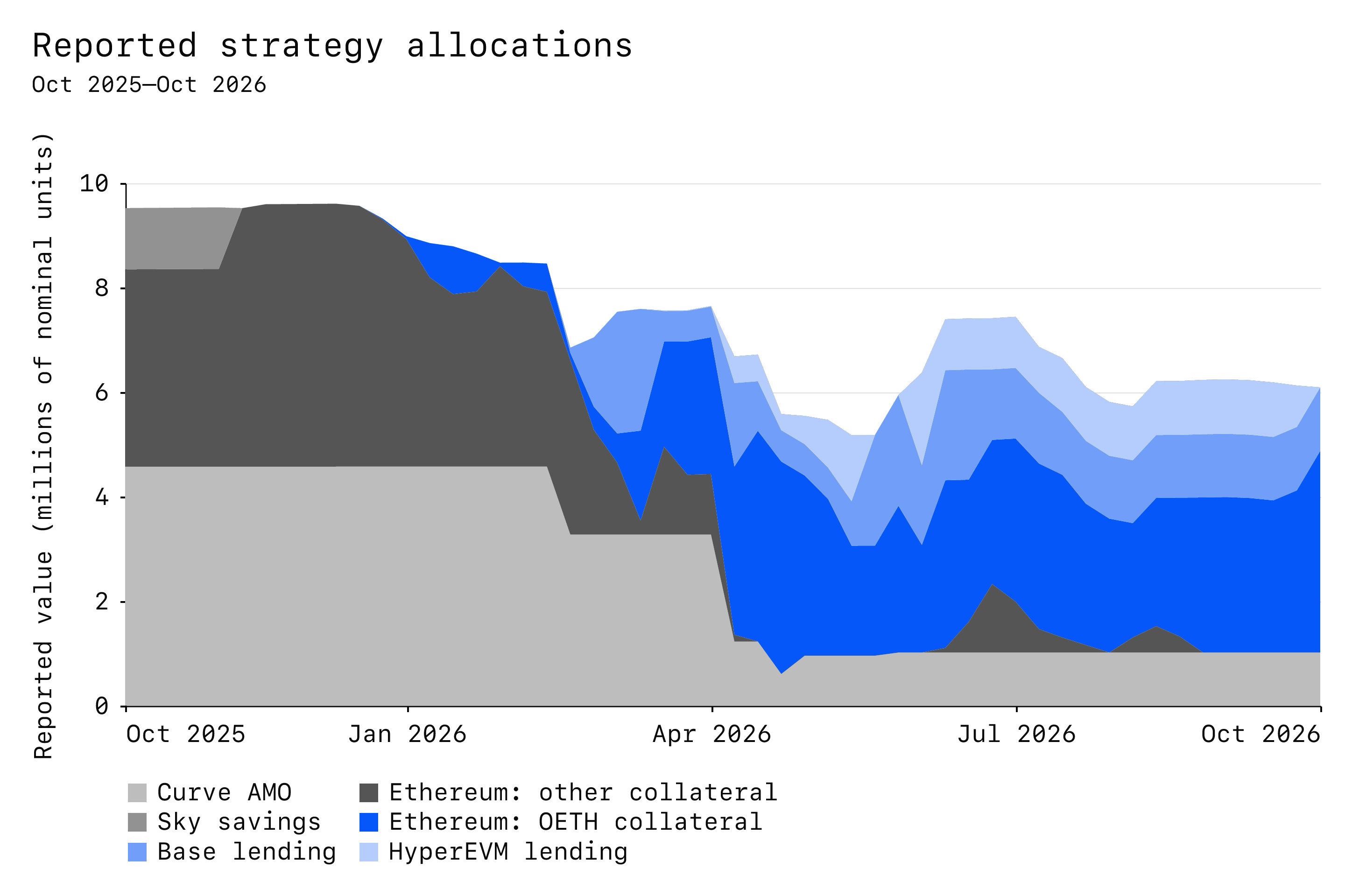
Figure 1. Reported strategy allocations. Source: weekly onchain measurements. Curve includes self-issued OUSD. Base and HyperEVM figures reflect the latest balances reported to Ethereum.13
Lending risks and loss allocation
Morpho lending can incur bad debt when liquidations fail to cover borrowers’ USDC debt. The lending vault bears its share of the shortfall.15 OETH collateral also carries staking and liquidity risks: validator penalties can reduce its backing, while delays in withdrawing staked ETH can constrain recovery.10
A lending loss does not necessarily reduce the underlying Morpho vault’s reported share value. Origin’s Ethereum lending strategy uses an outer Morpho V2 vault that invests through an underlying Morpho V1.1 vault. This underlying vault keeps recorded losses in the asset total used to price its shares, even though those funds are no longer available. That valuation passes through to Origin’s holding. Unless replacement funds cover the shortfall, earlier withdrawals can leave later redeemers bearing more of the loss.16 No bad debt was recorded.3
The current backing vault only rebases OUSD upwards, so strategy losses do not reduce holders’ token balances. If reported backing falls below supply, yield distributions stop. OUSD may trade below $1, and USDC redemptions can be blocked by the backing vault’s check. Overstated strategy values can conceal the shortfall. Enabling negative rebases would require a governance upgrade.21614
Yield and fees
Over the twelve weeks leading up to this review, Origin’s backing vault recognised about 87,200 USDC-equivalent of income. Roughly 68,100 came from lending and 18,900 from selling MORPHO rewards.17
The Curve AMO also earns trading fees and CRV rewards. Origin’s multisig collects CRV rewards and funds incentives for the OUSD/USDC pool.18
Origin takes 20% of OUSD yield before distribution, including yield earned through wOUSD. The underlying Ethereum Morpho vault separately charges a 5% performance fee paid to Yearn before its income reaches Origin.19 The backing vault smooths distributions using a seven-day setting, so yield reaches holders gradually.2
Yield is shared among rebasing OUSD, including the OUSD held by wOUSD. Contract accounts do not receive rebases by default. They can opt themselves in if their code supports the call, with no allowlist required; governance can also opt them in.20 Yield otherwise attributable to non-rebasing balances is shared among participating holders.2021 wOUSD’s annualised return over the twelve weeks was about 6.0% in OUSD terms.17
Exits and market liquidity
Holders can unwrap wOUSD into OUSD immediately and without a protocol fee, then either redeem OUSD for USDC through Origin’s backing vault or sell OUSD through Curve.1222
USDC redemption through Origin
A USDC redemption request burns OUSD and replaces it with a fixed USDC claim. There is no protocol redemption fee, but the submitted OUSD stops earning yield and the request cannot be cancelled or transferred. Payment requires at least ten minutes and enough USDC to fund the queue through that request, with no guaranteed deadline.26
The backing vault has no uncommitted idle USDC, so new requests need incoming funds or money returned from strategies. About 1.6 million USDC is available to withdraw through the Ethereum lending adapter.3 Origin says its automated funding job targets funding requests within 24 hours, allowing time for manual rebalancing if needed.21
Of roughly 1.2 million USDC supplied on Base, about 800,000 can be withdrawn locally. Most of the remainder is lent against superOETH and needs repayments or new liquidity.1123 Returning funds to Ethereum depends on Origin’s designated operator and Circle’s Cross-Chain Transfer Protocol (CCTP). The same operator initiates OETH’s validator withdrawals, so an interruption could delay both cross-chain returns and access to the ETH backing OETH.410
Governance can extend the minimum USDC redemption delay to fifteen days, including for existing requests, or disable requests and collection. The Guardian can also pause both immediately. Origin’s backing check can block collection during a reported shortfall, so available cash alone does not guarantee payment.62
Between February and October 2026, the backing vault received 193 USDC redemption requests totalling about 3.8 million OUSD. All but six small, fully funded claims had been collected. Recorded funding and the minimum delay were satisfied after a median of about five hours and a maximum of about 35 hours. These timings cover funding and the minimum delay; collection also depends on other redemption conditions and when holders claim.24
Selling through Curve
Curve provides a USDC exit without waiting for Origin’s redemption queue. The main OUSD/USDC pool holds about 615,000 OUSD and 405,000 USDC, allowing holders to sell close to its available USDC reserve with relatively little price impact.3
A sale of 375,000 OUSD quotes about 372,600 USDC, a 0.65% shortfall from nominal value. At 400,000 OUSD, quoted proceeds are about 393,100 USDC, a 1.73% shortfall. Beyond that, additional OUSD buys progressively less USDC as the reserve runs out.3
Liquidity dependencies and concentration
Origin’s AMO owns over 99% of the Curve pool’s LP shares. Its assets also count towards OUSD’s backing, so USDC redemptions and Curve sales draw partly on the same funds. Removing liquidity to fund vault redemptions leaves less USDC available to market sellers.35
The AMO requires reported backing to be at least 99.8% of OUSD supply after each deposit, ordinary withdrawal or rebalance. If a lending loss pushes backing below that threshold, even a withdrawal that would not worsen the backing ratio can fail, preventing a partial return of Curve funds to the vault. Withdrawing the AMO’s entire position skips this check, but would remove almost all liquidity from the pool.25
An Origin-linked 2-of-4 Safe holds about 85% of wOUSD supply, representing roughly 1.65 million OUSD. It shares all four signers with another Safe that transferred wOUSD to it, and two with Origin’s Guardian.2627
Pendle’s yield wrapper and Morpho’s pooled collateral contract hold a further 7.7% and 6.8% of wOUSD respectively.26
Issuer and organization
Origin Protocol Labs develops OUSD, OETH and related yield products. Its August 2026 disclosure identifies it as a Cayman Islands company led by CEO Rafael Ugolini, with co-founders Josh Fraser and Matt Liu serving at board level.28 Protocol changes are governed through xOGN voting and designated administrative roles, discussed under Governance and control.14
The company provides the website and interface, but its terms do not promise company-funded redemption or reimbursement for strategy losses. Holders depend on the backing and withdrawal arrangements described above; the reviewed materials establish no corporate guarantee or dedicated fund committed to covering an OUSD shortfall.2930
According to Origin, treasury assets fund ongoing development and operations, while net protocol revenue supports OGN buybacks distributed to xOGN stakers.2831
Governance and control
Voting and upgrades
wOUSD, OUSD and Origin’s backing vault are upgradeable proxies: governance can replace their code while keeping their existing addresses. This allows changes to core rules, including withdrawals and wrapper safeguards. Holders of xOGN, the staked OGN token, vote on proposals. The normal process takes roughly three days to reach the end of voting, followed by a minimum two-day execution delay; late quorum can extend voting.1431
Voting power is highly concentrated. Origin’s 5-of-8 admin Safe holds about 51% of total voting power. If it holds that share at a proposal’s voting snapshot, it can meet the 20% quorum and outvote all other holders combined. It can also cancel scheduled timelock operations. The Guardian is a separate 2-of-8 Safe with the same signers.1432
The three largest voting Safes together hold about 90% of voting power. The second and third share the same three signers, who also sign for the largest wOUSD-holding Safe. These connections concentrate voting authority among a small, overlapping group of signers.2732
Operational and strategy controls
The 2-of-8 Guardian can pause and unpause backing vault deposits and USDC redemptions, move funds among approved strategies and change yield-distribution settings without the two-day governance delay. It cannot independently upgrade contracts or approve new strategies.14 Configured operators can return strategy funds to OUSD’s backing vault through automation modules, without two Safe signatures per transaction.33
Origin’s Base strategy is administered through a separate two-day timelock. A 5-of-8 admin Safe can propose, execute and cancel those operations, rather than using Ethereum’s xOGN voting process.34
Origin describes the Morpho vaults as jointly managed: it sets market eligibility and allocation caps, while Yearn manages allocations within those limits.21 The onchain owner and curator roles are held by Yearn-associated administrators. Selected changes are delayed: increases to lending limits require three days, while changes to deposit or withdrawal restrictions in Ethereum’s outer vault require seven days.78
Wrapper safeguards and yield control
The current wOUSD implementation has no account allowlist, denylist or transfer pause. Pausing OUSD-to-USDC redemptions does not pause wOUSD transfers.12
The wrapper has a recovery function for retrieving unrelated tokens sent to it, but excludes OUSD so the function cannot remove holders’ backing.1
Origin’s yield-forwarding feature allows yield to be sent to another address, for example to fund liquidity or borrowing incentives.35 The Guardian can also apply it to the wrapper’s OUSD without the governance delay. If it did, wOUSD’s quoted conversion rate could keep rising without the wrapper receiving the corresponding OUSD, leaving insufficient backing for all holders to unwrap in full. This configuration was not active at the review observation.13637
Valuation and oracle considerations
wOUSD’s conversion rate can keep rising even if OUSD trades below $1 or USDC redemptions are blocked. It tracks OUSD’s rebasing rate, not the amount holders could recover by selling or redeeming OUSD.12
The oracles used to value collateral behind OUSD’s loans can miss discounts in OETH and superOETH. Ethereum’s OETH/USDC market uses ETH/USD and USDC/USD feeds, effectively valuing each OETH as one ETH. Base’s superOETH market similarly uses the same ETH-based oracle as its WETH market. If these tokens trade below ETH, the oracles can overstate what liquidators can recover from the collateral.38
The OETH/USDC market’s oracle also does not check how old its price data is. If its feeds stop updating while ETH falls, loans can appear better collateralised than they are, delaying liquidations and potentially increasing losses for OUSD’s lending strategy.38
Security and operational history
OUSD suffered an approximately $7 million exploit in November 2020. Origin attributed it to a missing validation check that enabled reentrancy, and responded with additional checks, reentrancy protection and further security reviews.39 A compensation programme opened in January 2021, offering eligible holders a combination of OUSD and, for larger claims, OGN locked for a year.40 The exploit affected an earlier version of OUSD. Today’s USDC-focused vault and cross-chain lending strategies use a materially different architecture.24
OUSD traded below $1 during the March 2023 USDC disruption. Following its November 2025 move to USDC-only backing, it has remained close to $1: approximately daily DefiLlama observations ranged from $0.994 to $1.008, with 99% within 0.5% of $1. These observations do not capture every intraday move.41
Origin maintains an Immunefi bug bounty offering rewards of up to $1 million for eligible vulnerabilities.42
Audit history
| Date | Audit |
|---|---|
| Dec 2020 | Trail of Bits and Solidified: OUSD |
| Dec 2024 | OpenZeppelin: OUSD delegation and Certora: OUSD verification |
| Apr 2025 | OpenZeppelin: WOETH and vault update |
| Feb 2026 | Sigma Prime: OUSD upgrade, v2 |
The 2020 audits cover earlier contracts. OpenZeppelin’s December 2024 delegation review assumed governance-controlled actions subject to a timelock; the Guardian’s current delegation powers do not have that delay. Certora’s verification covered OUSD’s token accounting rather than the interaction between yield delegation and wOUSD’s backing.431437
OpenZeppelin’s April 2025 review covers the conversion formulas used by the current wrapper. The deployed version includes subsequent changes, including to initialization, so the review is not an exact match for the deployed implementation.44
Sigma Prime’s February 2026 assessment covers the vault refactor and cross-chain strategies, excluding third-party libraries. Its work on rejecting stale incoming messages does not prevent a previously accepted balance from remaining in the vault’s accounts if reporting stops.45
Risk summary
wOUSD holders depend on OUSD’s backing, the liquidity available for exits and the administrators controlling both tokens.
- Lending is concentrated against OETH. About 63% of reported vault assets are lent against OETH, with further superOETH exposure on Base. Their lending oracles do not independently recognise discounts to ETH, so collateral values can overstate what liquidators could recover.
- Lending losses can fall disproportionately on later redeemers. The underlying Ethereum Morpho vault can keep recorded losses in its quoted share value. Earlier withdrawals can therefore leave remaining holders bearing more of a shortfall, with no junior tranche or dedicated funded backstop.
- The two exit routes share liquidity. USDC redemptions need funds returned from strategies, including operator-dependent cross-chain transfers. Curve offers an immediate alternative, but Origin owns over 99% of its liquidity. Moving that liquidity into the vault to fund redemptions reduces what remains available to market sellers.
- Concentrated governance can change rules and restrict exits. One admin Safe holds a voting majority and can determine ordinary upgrade proposals, subject to the governance process and timelock. Governance can extend USDC redemption waits or disable collection, while the 2-of-8 Guardian can pause redemptions immediately.
- Privileged yield redirection could underback the wrapper. The Guardian can divert the wrapper’s OUSD yield without the governance delay, allowing quoted claims to grow beyond its holdings. This requires an administrative action and was not enabled at the review observation.
Sources
-
Origin, active wrapper implementation and OUSD registry. ↩ ↩2 ↩3 ↩4 ↩5 ↩6 ↩7 ↩8
-
Origin, active vault implementation (VaultCore and VaultAdmin) and Pricing and Peg Management. The vault only calls
changeSupply()to increase supply. The OUSD implementation also permits a supply reduction, but only the vault can call that function; the current vault exposes no downward-rebase path. Caller permissions and both behaviors were checked on a local fork of the review block. ↩ ↩2 ↩3 ↩4 ↩5 ↩6 ↩7 ↩8 ↩9 ↩10 ↩11 -
yRisk calculations from onchain data for wOUSD, the OUSD backing vault and Curve pool. ↩ ↩2 ↩3 ↩4 ↩5 ↩6 ↩7 ↩8 ↩9 ↩10
-
Origin contracts: Ethereum master strategy and Base remote implementation. Circle, CCTP finality. ↩ ↩2 ↩3
-
Origin, Curve AMO implementation (Etherscan). ↩ ↩2 ↩3
-
Origin, VaultAdmin and VaultCore: withdrawal requests, delays and collection. Deployed code permits a fifteen-day delay despite an older seven-day comment. ↩ ↩2 ↩3
-
yRisk analysis of roles and delay settings in Ethereum’s V2 vault and V1 vault. ↩ ↩2
-
yRisk role and timelock checks of the Base outer Morpho vault and underlying vault; Yearn’s OUSD assessment. ↩ ↩2
-
yRisk calculations from Ethereum vault positions and Morpho core market records. ↩
-
Origin contracts: compounding staking implementation, beacon-proof verifier, OETH and vault (Etherscan). ↩ ↩2 ↩3
-
yRisk calculations from the Base V1 vault and its underlying Morpho markets. ↩ ↩2
-
Origin, Simplify OUSD, November 2025. ↩
-
yRisk analysis of 52 weekly onchain snapshots, 14 October 2025–6 October 2026. Gross strategy values include AMO-issued OUSD; Ethereum lending is split by underlying supplied positions. “Other collateral” includes idle market allocations. Supporting calculations. ↩ ↩2
-
yRisk analysis of the Ethereum timelock, governor, Guardian and admin Safe. Proxy upgrade controls: wOUSD, OUSD and the OUSD vault. ↩ ↩2 ↩3 ↩4 ↩5 ↩6 ↩7
-
Morpho, deployed Ethereum core: liquidation and bad-debt accounting. ↩
-
yRisk analysis of the MetaMorpho V1.1 vault, V1 adapter and V2 vault; Morpho, Managing bad debt. ↩ ↩2
-
yRisk income and wrapper-return calculations, 14 July–6 October 2026; reconciled against Origin backing vault events. Annualised return compounds the observed OUSD-per-share growth over a 365-day year. Remote income follows balances reported to Ethereum. Supporting calculations. ↩ ↩2
-
yRisk reward-flow analysis, 14 July–6 October 2026. Incentive transactions: 4,000 CRV on 17 August, 750 USDC on 31 August and 750 USDC on 14 September. OUSD and OETH rewards commingle, preventing attribution of individual CRV expenditures. ↩
-
yRisk fee checks for Origin’s backing vault and the underlying Ethereum Morpho vault. The fee recipient, 0xe5e2…89c0, is identified in Yearn’s OUSD report. ↩
-
yRisk analysis of OUSD rebasing balances and wrapper accounting; Origin’s yield bonus explanation. The deployed OUSD implementation permits self-opt-in through
rebaseOptIn()and governor-only opt-in for another account throughgovernanceRebaseOptIn(address). Source and runtime matched at the review block and 9 October 2026; caller permissions were tested on a local fork of the review block. ↩ ↩2 -
Origin, completed yRisk asset-review intake, exported 2 October 2026, and subsequent review feedback (team submissions). ↩ ↩2 ↩3
-
Curve, OUSD/USDC Curve pool contract source (Etherscan). ↩
-
yRisk Base-fork withdrawal simulations for the V1 vault and Origin’s V2 adapter. Tests cover local liquidity, not completed cross-chain settlement. ↩
-
yRisk reconstruction of 193 OUSD backing vault withdrawal requests, 18 February–6 October 2026. Funding-event timings are distinct from actual collection times. Supporting calculations. ↩
-
Origin, CurveAMOStrategy: deposit, withdrawal, full-withdrawal and rebalance checks. ↩
-
yRisk wOUSD holder census and Safe checks, including the Largest Safe and Morpho pooled collateral. ↩ ↩2
-
yRisk signer and transfer analysis of the Funding Safe and SY-wOUSD; Pendle’s asset registry. Connections do not establish beneficial ownership. ↩ ↩2
-
Origin, Token transparency filing, 13 August 2026 (issuer disclosure). ↩ ↩2
-
Origin Protocol Labs, Terms of service, 5 September 2024. ↩
-
Origin, Risk framework. ↩
-
Origin, Introduction to OGN. ↩ ↩2
-
yRisk reconstruction of xOGN voting records, checked against delegate balances and total voting power. ↩ ↩2
-
yRisk analysis of the Guardian’s enabled modules, including the automatic withdrawal module. ↩
-
Origin’s contract registry; yRisk checks of the Base admin Safe and timelock. Verified roles do not constitute a complete remote role census. ↩
-
Origin, Yield Forwarding. ↩
-
yRisk Ethereum-fork simulations, using seeded balances and impersonated administrative roles. Yield redirection is a hypothetical privileged scenario. Supporting calculations. ↩
-
Origin, OUSD implementation: rebasing and yield delegation. ↩ ↩2
-
yRisk analysis of the OETH/USDC oracle, feed inputs and Base superOETH/WETH oracle configuration. ↩ ↩2
-
Origin, What changed since the OUSD attack, 6 January 2021. ↩
-
Origin, Detailed compensation plan (22 December 2020) and compensation launch (20 January 2021). ↩
-
yRisk analysis of DefiLlama’s OUSD price history. Approximately daily observations, with gaps. Supporting calculations. ↩
-
Origin’s Immunefi program, updated 7 September 2026; Origin, bug-bounty documentation. ↩
-
OpenZeppelin, Origin OUSD audit (18 December 2024, revision 4495130); Certora, formal verification report (December 2024, revision 5e57112). ↩
-
OpenZeppelin, Origin WOETH and vault update (April 2025). ↩
-
Sigma Prime, OUSD upgrade security assessment, v2, February 2026. ↩